

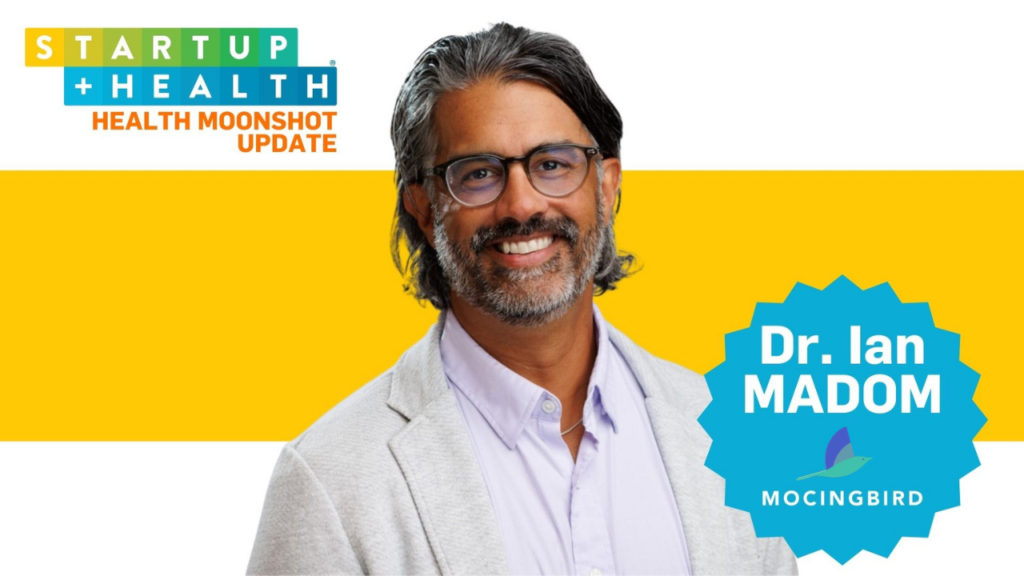
In the complex world of healthcare, clinicians and administrators often spend more time navigating licensing, compliance, and continuing education requirements than focusing on patient care. In a recent conversation with Unity Stokes of Startup Health, Mocingbird CEO and Co-founder, Dr. Ian Madom, shared how his firsthand experience as a practicing orthopedic spine surgeon inspired a technology-driven solution to streamline these administrative burdens. From managing multi-state licensure to automating compliance tracking, Mocingbird is transforming the way healthcare professionals stay up-to-date, freeing them to do what they do best, care for patients.
Below is the full conversation with Dr. Ian Madom, where he shares insights on how Mocingbird is transforming medical licensing, compliance, and CME for clinicians and administrators.
Unity:
Welcome. My name is Unity Stokes from Startup Health. Today, we have a wide-ranging conversation with Health Transformer extraordinaire Dr. Ian Madom, the co-founder and CEO of Mocingbird.
We’re going to go deep into what’s really going on in the world of health systems, administration, and how there are new platforms to help administrators and clinicians really manage the process of CME’s, compliance, licensing, and all those details that really bog the system down. So stick around for a wide-ranging conversation with Dr. Ian Madom.
Ian:
Hi, Unity. How are you?
Unity:
How are you, sir?
Ian:
I am pretty good. I’ve just finished clinic.
Unity:
The best part of my day is when I get to speak to a doctorpreneur who’s coming off the front lines. They actually know what’s going on. You’re talking to patients, you’re doing real work.
Ian:
I appreciate that very much. It’s a labor of love that I’m not sure my wife always appreciates, but she certainly understands it.
Unity:
Well, I’m really excited to catch up because one of my mantras is that a lot of the best innovation in the world is the simplest. It’s the most elegant. I think what you and Mocingbird have been bringing to life is one of those things because it’s one of the unsung innovations that is really improving people like your peers’ lives and administrators’ lives through the whole system. So I’m excited to catch up with you and all the great work that Mocingbird is doing.
But I thought we’d start with you because, as we were just saying, you’re a practicing doctor, you’re a clinician. Tell us about your background. Tell us about you and the beginning of your journey of getting into healthcare and why you went into healthcare, and then what led you to launch Mocingbird.
Ian:
Yeah. So my father is a physician. He’s a pediatrician. My mother was a pediatric nurse. They met back in Brooklyn when they were young. And I have always been around healthcare. I like to say I’ve been in healthcare for 49 years, since I was a baby. After my father’s residency at Long Island LIJ Hospital, now Northwell, we moved to Eastern Long Island. We had a house. It was like this ranch house, and one side of the house was his office and the other side we lived in. So, I’d be playing in the waiting room as a little kid while my father was seeing patients. Healthcare has always been around in the house.
As I grew up, I realized that I did want to go into healthcare. I think I spent a couple of afternoons with my father, who quickly told me I wasn’t cut out to be a pediatrician. I should be a surgeon because I had a surgeon mentality. I ended up choosing that. I’m an orthopedic spine surgeon.
And the one thing that doctors love to do is complain.They love to complain about the problems in healthcare. The one thing I learned from my dad was, don’t complain unless you have a solution to it and start to fix the problems that you see that are present. So I always felt like I had that mindset early on in my career. I was lucky enough to go do an executive MBA at Yale, where I met a lot of other clinicians and people in healthcare. I met my co-founder for Mocingbird there, and we spent a lot of time outside of class talking about the problems, but also the solutions that maybe we could bring to the ecosystem.
One of the things we really spent a lot of time on, from our own pain points, was all of these different certifications that we just have an impossible time tracking, along with all the compliance that goes along with them, which is mostly education-based. Can’t we do this in a simpler way with software and bring a real, as you said, simple solution to clinicians’ lives?
At the end of the day, I just want to take care of people. I want to be in the office seeing people. I want to be in the operating room taking care of people and fixing their problems with their neck or their back. I don’t want to be figuring out what I need to do just to be able to do that. I have no problem doing the education. I believe in education. I spent years learning things. But spending time looking up what I need to do and then going out and trying to find it in a way that’s very labor-intensive just didn’t make sense. We felt like there had to be a better way. So we brought one to the market.
Unity:
So you and your co-founder, also a doctor, right? George Fernaine, MD, MBA. You came up with this solution, Mocingbird. How do you describe Mocingbird today to the world?
Ian:
Mocingbird is a SaaS product, a piece of software that takes all of your different credentials, your license, your certifications for narcotics, and even your board certification, which will soon be included, and manages all of the compliance needs required to renew those certifications. It does this in a way that is timely, gives you the information you need, and points you in the direction of the education you need to complete so that when it’s time to renew that certification, you’re ready to go.
Unity:
And I don’t think a lot of people realize this, but it becomes like a game of 3D chess when it’s state by state in some cases, and there are just so many things involved. Tell us a little bit about the administrative reality of healthcare today. What’s really going on? And within the context of this solution, the SaaS solution automates things not just for individual clinicians and physicians, but also for administrators. What’s the administrative reality today?
Ian:
We learned that early on through our own personal experience. When we were starting, it was a time when we proved we were in the right space. One of the admins who supported my practice at the time said, “Hey, you have a renewal coming up for the state of Rhode Island, your main state of practice. You have eight hours of opioid training due. By the way, I know it’s Friday of Memorial Day weekend and it’s due on Tuesday. Here are 40 different websites you could go look at to figure out what you need to do.” At least she started the process for me.
The issue in our fragmented system is that every state has its own set of requirements that change on a yearly basis. Many of them overlap, but some of them don’t in terms of what the requirements are. But how to achieve compliance doesn’t necessarily overlap. Some may require the same course. Others may require a state-specific course. And then the timeline is where things really get tricky, that three-dimensional chess you’re talking about. Sometimes these credentials expire on your birthday. Sometimes they expire on June 30 or January 31. Sometimes it’s based on the date they were issued. No state is consistent in how they do it.
So when you talk about a piece of software, how does it achieve compliance for you so that you’re not spending extra time doing education you don’t need? If you’ve already done that education, it applies it to the license as needed. But then from one cycle to the next, how do you make sure you’ve done the education at the right time? Based on when I did this piece of education, can it be applied to this state cycle and not that state cycle?
That’s an important piece because we find a lot of people are actually out of compliance, and then they’re doing last-minute education. To me, last-minute education is effectively just paying a toll or a tax. You’re trying to get it done as quickly as possible. There’s no real opportunity to learn anything from it. The state’s intent isn’t achieved in a meaningful way because people are just trying to check the box.
Unity:
Yeah. And it seems like you’ve taken what often becomes a very reactive situation, where maybe an administrator is reminding you two hours before something is due or four days before over a holiday weekend, and you’ve turned that scramble into an automated system.
A system that can be done thoughtfully and manage the logistics for both the clinician and the administrator. Am I getting that right? It’s not just for individuals. It’s also for a system overall to help with that administrative burden.
Ian:
Yeah. We learned that the admins supporting us are just as burdened by this, and they were tracking it on spreadsheets. We wanted a way that could connect them to their clinicians so they’re not just sending emails, many of which go unanswered, and instead have a system that notifies the clinician. At the same time, admins can see where their whole organization stands because they’re responsible for the overall compliance of their workforce.
As we have grown, we’ve spent more time on the administrative tools to the degree that in the coming months we will release a separate piece of software for admins to use on their own. They can run the initial licensing for their clinicians, manage renewals, and see where compliance stands for their clinical staff all in one place.
So now we can really focus on Mocingbird being primarily clinician-based, that interface where the inputs are coming from the clinician. They’re learning and tracking. The admin then has their own piece of software that looks at the overall organization and allows them to execute on things like obtaining two new state licenses or managing three upcoming renewals. They can get all of that done in-house. That’s where we’re moving as an organization, very focused on the admins that support us.
Unity:
Well, that’s so helpful. Obviously in a post-COVID world, telehealth has taken off. There’s increased demand for care, and a lot of the demand is shifting to specialty care and across state lines.
You launched in 2017, right? I’m curious what you’ve seen change. It seems like this solution is even more relevant today as clinicians operate across multiple states. That means more licensing requirements, more CME requirements, and more logistical things to manage. Am I getting that right?
Ian:
Yeah, 100 percent. When we started, we really began the work in 2018 and then tried to go to market at the beginning of 2020. That didn’t really work because there was a pandemic going on. So we effectively went to market in 2021. That was right around the time when telemedicine and virtual care were starting to grow.
Our biggest wedge in the market, where we were most effective up until about a year ago, was virtual care. Even now, especially on the behavioral health side, virtual care has been a big part of our growth story. But now we’re starting to see health systems jump in and say that not only do they have virtual care, they also have clinicians practicing in multiple states because that’s how their clinical operations function.
The strategy of having clinicians be multi-state licensed has become an effective reality for them. The growth of the interstate medical licensure compact, which we work very closely with, is a big part of that story. We’re developing their new portal, which will be released over the coming months. It has become easier to hold licenses in multiple states because of a system like Mocingbird. In the past, you had no idea where you stood. Now you can reach a larger number of patients. It makes access easier for patients and clinical operations easier for organizations when clinicians hold multiple state licenses.
Unity:
Right. Because each state has different board requirements. Then there are different timelines. Some expire on birthdays, some at year-end. There are ongoing renewals and multiple layers involved. Is Mocingbird an end-to-end licensing support platform?
Ian:
Now it is. This new piece of software really does the end-to-end work for admin staff. They can obtain someone’s initial licensure, monitor their ongoing compliance, and then renew their license, controlled substance registration, or DEA registration, whatever that requirement may be for the organization. They can run that entire process end-to-end.
Unity:
That’s great. One of the hot topics right now is workforce shortages in healthcare. We see a lot of job growth in the industry, but we still see clinician shortages. Many people assume it’s just that there aren’t enough clinicians. But one of the things I learned while researching is that it’s not just about numbers. It’s also about compliance issues and licensing delays. Can you talk a little about how your solution helps address workforce scalability issues and delays that people may not think about?
Ian:
Workforce management has been a focus of our industry for some time, but mostly around scheduling or making sure the right clinician is in front of the right patient. Only in the past 12 to 18 months have people begun focusing on access. There are huge geographic areas where patients are underserved because there isn’t physical access to clinicians.
That’s where virtual care has an opportunity to help patients in the United States. We’ve grown in our ability to care for people virtually. We don’t always need to perform an exam in the room. We can conduct an exam on camera. We can certainly address behavioral health issues virtually. Comfort with virtual care will continue to grow.
If patients can access care even when their clinician isn’t in their local geography, it helps them tremendously. From a clinical operations standpoint, larger health systems also understand that some care requires travel while other care can happen closer to home. There’s growing interest among health systems to expand beyond their local geography.
They may bring patients in periodically for testing, but more routine interactions can happen closer to home or virtually. To execute on that strategy, clinicians must be licensed in the state where the patient is located. It’s not enough for me to have a Rhode Island license and treat someone anywhere in the United States.
State licensure exists to protect patients and ensure patient safety. Each state sets its own standards for delivering care. Even the interstate medical licensure compact is not designed to nationalize licensure. It allows states to maintain sovereignty over their licensure processes while agreeing on shared standards.
These are complex interactions within the ecosystem and heavy lifts for admins and clinicians. It can make people want to throw their hands up. That’s why you need a simplified solution that tells someone exactly what they need to do so they can continue caring for their patients.
Unity:
Earlier you mentioned you’re an orthopedic surgeon and you also mentioned behavioral health. Is this a solution across clinician types and specialties?
Ian:
Yes. Initially we focused on physicians because that was my personal pain point. But we also support nurse practitioners and physician assistants. We’ve seen incredible growth in those professions over the past five years. That’s partly a health economics issue and partly an education access issue. There are only a limited number of medical school spots, and that number hasn’t grown significantly with the population.
We have seen growth in nurse practitioner and PA programs. We also support behavioral health professionals, including licensed clinical social workers and LMFTs. Behavioral health is a major component of addressing the clinician shortage in the United States. Access to behavioral healthcare starts with having clinicians licensed in the states where patients live. So we support nurses, behavioral health professionals, and will continue expanding into other areas as our customers grow.
Unity:
It’s an amazing solution and great to see your growth. We’re living in this new world of AI. I’m curious about your perspective on innovation today. What’s surprising you the most and what excites you the most?
Ian:
AI is obviously a hot topic among clinicians, investors, and people across industries. What people are starting to realize is that there are multiple types of tools within the artificial intelligence ecosystem, and not all tools are meant to solve the same problems. You have to match the right tool to the right problem.
For Mocingbird, we’ve leveraged some AI models and tools on the backend to help our system scale and achieve certain outcomes. Large language models have been part of that. Some people say they could just go to ChatGPT to find their licensing requirements. There are risks with that because large language models perform best when directed at specific, structured data sources rather than the entire internet.
If you point them broadly at the internet, you risk pulling incorrect or outdated information. The role of AI is to place these tools in a structured environment where they can retrieve specific information, complete a task, and return that information to the platform. Then the platform delivers it to the user in a meaningful way.
That combination of AI tools and human design is what ultimately makes the information useful for the user.
Unity:
Totally. And how do you like being a doctorpreneur? What’s that experience been like while you’re practicing and building a company?
Ian:
It’s hard but rewarding. It’s lonely yet engaging. It’s all of these things at opposite ends of the spectrum. There’s a push and pull every day. Some days I ask myself why I’m doing this, and other days I know exactly why I’m doing it.
It really depends on the day you catch me. Today is a day where I feel inspired and empowered. Other days feel different. But if you talk to entrepreneurs, you’ll hear the same thing. Some days feel difficult and others feel like you’re going to conquer the world. That’s both humbling and exciting about building things that help people.
Unity:
I love the work that Mocingbird does because it enables clinicians to do what they do best, which is spend time helping patients rather than dealing with licensing logistics. That’s really wonderful to see. What’s next for Mocingbird? Anything you want to share?
Ian:
The biggest thing we’re excited to share is the new end-to-end licensing platform that we will bring to market in the coming months. We’ll launch with two beta customers in April and plan a general release in June. We think it will help many organizations that are trying to manage licensing internally but cannot scale their teams fast enough to bring clinicians in and put them in front of patients.
Unity:
Incredible. It’s amazing to see the progress you, George, and Stacy keep making. It’s really fun to watch and be part of in a small way. Where should people go to connect with you about business opportunities?
Ian:
They can go to Mocingbird.com. MOC stands for Maintenance of Certification, which is why we called it Mocingbird. A mockingbird echoes the voices around it, and we are echoing the voices of clinicians. People can visit Mocingbird.com to learn more. You can also find us on LinkedIn and other social media platforms.
We really appreciate the support Startup Health has given us over the years. You’ve been an incredible partner, from our time at ViVE and Health to podcasts and other collaborations. We appreciate everything you’ve built, Unity, in supporting companies like ours and helping change the lives of healthcare professionals and the patients they serve.
Unity:
Thank you so much. I appreciate that and hope to see you very soon.
Ian:
Very good. Be well, Unity. Thank you so much.
About Mocingbird
Mocingbird is a SOC 2 and HIPAA-compliant, physician-founded, cloud-based platform revolutionizing the way healthcare professionals and organizations manage medical licensing and Continuing Medical Education (CME) requirements. By automating the entire licensing process—from initial applications to renewals and CME tracking—Mocingbird helps clinicians stay compliant and focus on patient care while reducing administrative burdens. With a team of licensing experts and a comprehensive, user-friendly dashboard, Mocingbird ensures that clinicians and healthcare organizations meet all regulatory requirements with ease. Trusted by medical professionals nationwide, Mocingbird is committed to improving clinician well-being and operational efficiency across the healthcare industry.